Tuesday, March 27, 2012

The World of Downton Abbey

Fellowes, J., & Briggs, N. (2011). The world of Downton Abbey. New York: St. Martin's Press.
 
Loved.  It.  Lots of behind the scenes info and historical notes.

My Name is Mary Sutter

Oliveira, R. (2010). My name is Mary Sutter. New York: Viking.
 
I liked this one a lot, though it got a little boggy in the middle.  The main character is a larger than life midwife from Albany named Mary Sutter.  She wants more than anything to become a surgeon, but no schools will admit her because she's a woman in the 1860s.  She approaches several surgeons, begging them to take her on as an apprentice, but nobody bites.  When the Civil War breaks out, she goes to Washington DC to try and join the nursing corps Dorothea Dix pioneered, but she's not old enough, and is single.  She perseveres and faces tragedy, but ultimately does gain medical training.

Thirteen Hallows

Scott, M., & Freedman, C. (2011). The thirteen hallows. New York: Tor.
I was really excited to read this book, because Michael Scott is a mythology expert, and his kids books (Nicholas Flamel series) are fun.  This didn't excite me so much as I thought it would.  It's a bit slow with characterization, and the reader doesn't end up feeling that much for the characters.  The pacing is a little too fast for adult readers, much like Dan Brown's books; it feels a bit contrived.  The ending is very rushed, and though there apparently will be a sequel, I doubt I'll read it.  It wasn't great, but there are so many books on my to-read list, I have to be selective.

Wednesday, November 9, 2011

Brave New World

Huxley, A. (1969). Brave new world. New York: HarperPerennial.
 I listened to the audiobook, and I'm such a visual learner that I had to check out the print version to read some of the names in particular.  I can't believe I've never read this book before now, and I have mixed feelings about it. This book is creepy.  It's all about a future society where people are reproduced in a laboratory/test tube situation, without families.  Mother and father are actually shocking words because they're unknown.  People are essentially raised in laboratories, created into a caste system where their fate is as predetermined as their jobs.  People are encouraged to take a drug called Soma to numb their emotions, promiscuity is the norm, and monogamy is frowned upon.  Children are "conditioned" with sayings repeated over and over, until they become truth. 
A man named Bernard Marx and his friend Lenina go on a trip to a reservation in New Mexico, where they meet Linda and John.  Linda grew up in London, but shockingly became pregnant with John, which is why they are on the reservation.  They eventually accompany Bernard and Lenina back to London, where Linda dies, and John becomes a novelty in London society, known as "the Savage".  Through John's eyes, we realize how dystopian society has become.  John becomes as hounded as a modern day movie star dodging paparazzi, and becomes the unwilling star of a "feelie", or movie. 
I thought it was incredible, and disturbing, how many of Huxley's predictions came true.  This book was written in 1932, and yet features in vitro fertilization, paparazzi, etc.

Tuesday, November 1, 2011

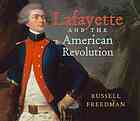
Lafayette and the American Revolution

Freedman, R. (2010). Lafayette and the American Revolution. New York: Holiday House.
I really enjoyed this book, but I am a history buff.  Here we learn about the Marquis de Lafayette, who came to fight in the American Revolution from his homeland in France.  Many people don't realize the important role that Lafayette played in our nation's history; not only did he actually fight in battles, but he convinced the French government to send money, troops, and weapons.  This backing was vital to the American victory. 
There are lots of pictures, including many in color.  While there's a lot of material covered here, I think it's done in an exciting way that will hold readers' attention.

Monday, October 31, 2011

John Lennon: All I Want is the Truth

Partridge, E. (2005). John Lennon: All I want is the truth : a biography. New York, NY: Viking.
This is a fairly detailed biography of the famous Beatle, from birth to beyond his death.  While some biographies gloss over the subject's flaws, this author definitely does not do that.  Lennon's obsessive personality, drug use, promiscuity, and anger/abandonment issues with his family are all addressed honestly.  From his humble beginnings in lower class Liverpool to the soaring heights of Beatlemania, Lennon's genius is given the attention it deserves, but balanced with the struggles of fame, like loss of privacy and control by managers.  As a Beatles fan, I enjoyed learning more about Lennon, but this is suitable for older teens because of the subject matter.

Tuesday, October 25, 2011

Ideas that Changed the World

Ferris, J., & DK Publishing, Inc. (2010). Ideas that changed the world. London: DK.
This is a really cool book!  It is separated into six categories: genius, great gizmos, handy gadgets, on the move, explore, and culture.  Under each category are double-page spreads of an idea with beautiful pictures (It is DK, after all!) and interesting tidbits of information.  The year and person responsible are included for each idea.  For many of them, the idea is explored from the past, present, and into the future. 
I had this book on my desk at school for over a week, and I had several kids who would fight over it.  I had to have them pick a number between one and ten every day, or take turns with it.  They were really ready for me to turn it in so they could have it!  I love DK books, and this is no exception.

Monday, October 24, 2011

You Hear Me? Poems and Writing by Teenage Boys

Franco, B. (2000). You hear me?: Poems and writing by teenage boys. Cambridge, Mass: Candlewick Press.
This is a touching collection of poetry written by teenage boys.  Some of them are light, and some are definitely heavy, but they are all honest.  The quality varies, but of course that's a matter of opinion, and poetry is subjective.  I did enjoy reading it, and some of them really spoke to me.  Most of the boys just want to me heard, and loved, and appreciated, and many poems are addressed to the boys' fathers.  Some of the language and content is mature, so this would be most appropriate with older teens.

Wednesday, October 19, 2011

Flygirl

Smith, S. L. (2008). Flygirl. New York: G. P. Putnam's Sons.
This is a really great piece of historical fiction.  It's the story of Ida Mae Jones, a pale African-American girl in New Orleans at the beginning of World War II.  Ida Mae's father has died, but he was a pilot, and he taught her to fly.  When the war breaks out, her older brother Thomas joins as a medic.  Soon, Ida Mae hears about the WASP program for women pilots, and wants to join, but they do not accept black women.  Ida Mae decides to "pass" for white, and joins.  She meets two wonderful friends, goes through the rigorous training, and becomes a pilot.
Throughout the story, Ida Mae faces discrimination from people because of her skin color and her gender.  She lives in fear that she will be discovered and killed for passing as white.  There are several intriguing storylines, including her brother going missing in action, a death, and a budding romance.  I think this is a fantastic story for young girls to read.

Monday, October 17, 2011

Chains

Anderson, L. H. (2008). Chains. New York: Simon & Schuster Books for Young Readers.
This book tells the story of Isabel, a slave in the beginning of the American Revolution.  As the story begins, her mother has died, and Isabel and her sister Ruth are sold to a New York couple instead of being freed.  "Madam" mistreats the sisters, renaming Isabel "Sal" and selling Ruth when she finds out Ruth has seizures.  Isabel meets Curzon, who is a Patriot, and he talks her in to spying.  When Isabel gets in trouble, Madam has her branded with an I for insolence, and Isabel gets sick.  Curzon is wounded and imprisoned, and Isabel sneaks food to him.  Finally, Isabel works up the courage to run away after she realizes that Madam is going to sell her.  She sneaks Curzon out of prison, and the novel ends with a cliffhanger. 
I enjoyed this book, especially seeing Isabel grow and gain courage as a young woman.  She grew to mistrust others, but to depend upon herself.

Thursday, October 13, 2011

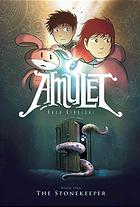
Amulet

Kibuishi, K. (2008). Amulet: Book 1. New York: Graphix.
Amulet is the story of Emily and Navin, brother and sister.  After their dad dies, their mom decides to move to an abandoned, run down shack of a house that belonged to their great-grandpa.  Emily finds a her great-grandpa's library, where she discovers an amulet that won't come out. After their mom hears a noise, from the basement, she is captured by a jelly-like tentacle-y monster, and to save her, they go out this door, which leads them to a parallel universe. The amulet helps them to a lake, where a trench coat-wearing guy leads them to an old house. The guy turns out to be a pink rabbit named Miskit. In the house, Silas (great grandpa) is dying. He tells Emily she has to take care of the stone. She accepts, and then she, Navin, Miskit, and friends go to rescue their mom. They do, but she is poisoned, and to find the cure, they must travel across the world.
I found this to be bizarre, and creepy.

Wednesday, October 12, 2011

Complete Persepolis

Satrapi, M., & Satrapi, M. (2007). The complete Persepolis. New York: Pantheon Books.
The Complete Persepolis is a graphic novel illustrated and written by Marjane Satrapi. It is about Marji herself, who grew up in Iran during the Islamic Revolution. She and her mother were protesters against "the veil" they were forced to wear, until they got hurt. Marji's mom and dad got her out of Iran after Marji got kicked out of school because she refused to not wear jewelry and jeans, and she moved to Austria when she was 14. From there, because her mother's friend kicked her out of where she was supposed to stay she moved around Europe until she got really lonely and moved back to Tehran. There, she met Reza, who she married. Then she got an Art degree and had to move back out of Iran when she was 24.
I'm not the biggest fan of graphic novels, so I wasn't thrilled to be reading this.  It is a good story though, and it's a fast read.  It's a good example of religious, social, and cultural information in an artistic format.

Monday, October 10, 2011

Madapple

Meldrum, C. (2008). Madapple. New York: Alfred A. Knopf.
This is a very bizarre book that sort of defies description.  Aslaug lives with her mother in rural Maine, and they are totally cut off from the outside world.   Her mother is some sort of botanical genius, so they forage for a living, and her education has been very nontraditional - she knows several ancient languages and tons of botany, but nothing of the modern world.  Her mother, Maren, seems insane, and then dies of cancer.  Aslaug is accused of her murder, but it is determined that she overdosed herself on jimsonweed but had terminal cancer, so Aslaug goes to find her aunt and cousins in a nearby town.  The aunt is an evangelical preacher, and her cousin Sanne appears to be as crazy as Maren was.  Her male cousin, Rune seems to have incestuous feelings for Aslaug.  One storyline involves her quest to find out who her father was.  Aunt Sara claimes her ex-husband Mikkel fathered her, but Sanne (and Maren) believe there was an immaculate conception.  Another storyline involves theological discussions on Christianity's co-opting of many pagan ideas.  Aslaug quickly ends up pregnant at age 15, like her mother before her, but has no memory of ever having sex, other than a dream of her cousin Rune.  Sanne convinces her it was immaculate conception again, though she has actually drugged the household so that Rune would impregnate her.  Bizarre!  She has the baby, and they raise her communally, along with another teen pregnant by Rune.  Rune and this girl eventually run off with the baby, causing Sanne and Sara to commit suicide and Aslaug to be charged for their murder.  Rune finally saves to day, and I guess they all live happily, incestuously ever after.  Definitely one of the weirdest books I've read in a while.  It was like a mix of DaVinci Code and V.C. Andrews.

Tuesday, October 4, 2011

London Eye Mystery

Dowd, S. (2008). The London Eye mystery. Oxford: David Fickling Books.
The London Eye Mystery was cute, but I did not fall in love with it.  It's a really quick read, with chapters that are just a few pages each.  It's told from Ted's point of view, and he's a Londoner who happens to be autistic.  His "brain is wired differently", as he says.  His autism is covered in a very positive, though realistic light.  His family is very supportive, but they do occasionally get a little frustrated with him.  He works on his social skills with a therapist, and there are reminders of his lessons throughout the book.  Ted's aunt Gloria, and cousin Salim come to stay with them on their way out of the country to move to New York.  They decide to ride the London Eye, and Salim disappears - he goes up in the Eye then never returns.  Ted and his sister Kat work as amateur detectives to figure out what happened to Salim.  The family gets very stressed out as the kids race to solve the mystery.

Friday, September 30, 2011

Uglies

Westerfeld, S. (2005). Uglies. New York: Simon Pulse.

I didn't love Uglies as much as I loved Hunger Games – it just didn't grab me in the same way. Tally isn't as appealing a character as Katniss, and the world isn't as believable, I didn't think. Uglies is good, I think, just not when it's compared to Hunger Games. In Uglies, people are convinced that they are ugly unless they have an operation to make them “pretty”. I guess it's kind of like growing up in Beverly Hills or Orange County, California. ;) Tally wants to become pretty, and sneaks out to see her old friend, who is already pretty. There, she meets Shay, and her life changes. When Shay runs away, Tally's forced to find her, and goes on her hoverboard to find the rebels at The Smoke. The novel kind of lost me here; I got bored. She meets David, and she has a moral dilemma. I didn't hate this book, I just did not love it, or Tally. The message of nonconformity and questioning authority instead of blindly accepting things is a decent one.

Monday, September 26, 2011

Hunger Games

Collins, S. (2008). The Hunger Games. New York: Scholastic Press.
In the Hunger Games, we meet Katniss Everdeen, a teen girl who lives in District 12 of Panem, a future version of the United States.  The districts rose up against the Capitol long ago, but lost, so the Hunger Games are their punishment.  Every year, children ages 12-18 put their name into a drawing, and each district sends one boy and one girl to the Games.  Life in District 12 is hard, and Katniss has been providing for her mother and little sister since her father died several years ago.  She sneaks out of the city with her friend Gale and hunts with a bow.  Her sister Prim is chosen for the Games, but Katniss replaces her and is sent with Peeta, the baker's son.  Life in the Capitol is very different; people are vain and shallow, but Katniss grows fond of her style team, particularly Cinna, who dresses her in fire.  The Games are a brutal fight to the death, and over the days in the arena, the tributes die one by one.  Her relationship with Peeta grows, as they work together.  In the end, they both survive, but that has angered President Snow.

I can't say enough about this book.  It is wonderful, and  really makes you think about our society and whether we might be headed towards a future like this.  My daughter wanted me to read this for a while, and I'm so glad that I finally did!  I can't wait to see if the movie does it justice.

Saturday, September 24, 2011

Beautiful Creatures

Garcia, K., & Stohl, M. (2009). Beautiful creatures. New York: Little, Brown.
Beautiful Creatures was okay, but not as good as I thought it would be. I kept thinking that it was a cross between the TV show Vampire Diaries (with the Civil War stuff) and Twilight. I guess I couldn't help thinking it should be more original. I gave it to my daughter after I read it though, and she liked it a lot. That's actually strange because she hated Twilight, and hasn't ever seen Vampire Diaries. There were lots of cliches here, and I didn't find Ethan to be very believable as a character. I couldn't really tell, however, that the book has two authors, so they wrote together well. My daughter will be reading the sequel, but I will pass.

Tuesday, September 20, 2011

Graceling

Cashore, K. (2008). Graceling. Orlando, FL: Harcourt.
I loved Graceling. This book was spectacular.  Katsa is a graceling, someone with a gift.  Her gift is combat, and specifically killing; she can not fail.  This is a mixed "blessing", and Katsa is forced into life as an assassin for the king.  She meets Prince Po in a secret organization, and they slowly become friends.  Po is looking for his grandfather, and he is graced in fighting.  The two are almost evenly matched, which is new for Katsa.  Though the two fall in love on their quest, Katsa refuses to marry, as she thinks women lose their independence.  They prevail against the mind-controlling evil king in the end.  I can't wait for the sequel!

Thursday, September 15, 2011

Along for the Ride

Dessen, S. (2009). Along for the ride: A novel. New York: Viking.
I liked this book a lot, and think that older teens will like it.  It's definitely a girl book, and one that will especially appeal to academically inclined girls.  Auden, the main character, has two college professor parents who expect great things for her education.  She has had a socially stunted life, with her entire focus on school.  The summer after she graduates high school, she goes to stay with her father, stepmother, and newborn baby sister.  Heidi, her stepmother, is very girly, but smart and successful at her clothing store.  Auden goes to work there, and makes friends with other girls who work there.  The others teach her how to be a girl, and how to have fun.  A local boy named Eli, a fellow insomniac, hangs out with her every night, and they check off things Auden never had a chance to do as a kid, like learning to ride a bike.

Tuesday, September 13, 2011

November Blues

Draper, S. M. (2007). November blues. New York: Atheneum Books for Young Readers.
I did not love this book.  It's about November Nelson, a teenager in Ohio, whose boyfriend has just died.  Josh and November had been a teenage "power couple" in their school, and he died in a hazing incident.  Soon after, November realizes she is pregnant.  The discomforts of pregnancy are realistic, but I thought the slang was forced.  November has a disabled brother, which has made her interested in a career helping the disabled, but there's no other mention of him... where he lives or anything.  November's mother is devastated, but supportive.  School friends named Olivia and Jericho also lend their support.  The climax, a roadside labor and helicopter evacuation, with Josh's parents trying to buy the baby, seems forced.